The heart of Lent: Repent and believe in the Gospel.

***

Gospel: Luke 13: 1-9

Some people told Jesus about the Galileans
whose blood Pilate had mingled with the blood of their sacrifices.
Jesus said to them in reply,
“Do you think that because these Galileans suffered in this way
they were greater sinners than all other Galileans?
By no means!
But I tell you, if you do not repent,
you will all perish as they did!
Or those eighteen people who were killed
when the tower at Siloam fell on them—
do you think they were more guilty
than everyone else who lived in Jerusalem?
By no means!
But I tell you, if you do not repent,
you will all perish as they did!”

And he told them this parable:
“There once was a person who had a fig tree planted in his orchard,
and when he came in search of fruit on it but found none,
he said to the gardener,
‘For three years now I have come in search of fruit on this fig tree
but have found none.
So cut it down.
Why should it exhaust the soil?’
He said to him in reply,
‘Sir, leave it for this year also,
and I shall cultivate the ground around it and fertilize it;
it may bear fruit in the future.
If not you can cut it down.’”

The Gospel of the Lord.

***

The Scarlet Letter: Part 1. “The Scarlet Letter” by Nathaniel… | by Lynn  Moynahan | Medium

***

Back in high school English, some of us may have read Nathaniel Hawthorne’s famous novel, The Scarlet Letter.

It’s the story of a young woman, Hester Prynne, who becomes pregnant out of wedlock. Shamed by her Puritan neighbors, Hester is forced to wear a scarlet “A” to remind her – and everyone in town – of her sin.

By the end of the story, the father of this young child is revealed. In a passionate dialogue with Hester, he confesses:

“Of penance I have had enough. Repentance, none at all.”

***

This father’s inability to publicly claim – and love – his child was his penance. And in spite of living his life in secret, he wasn’t sorry; rather, it seems he would do it all over again. 

“Of penance – of living my life in secrecy – I have had enough.” 

“But repentance – of being sorry for my actions – none at all.”

***

Herein lies the difference between penance and repentance.

40 days of fasting, meatless Fridays, no chocolate, no social media, no soda – or whatever we’re giving up this Lent – is enough penance for the year.

By Easter, we’ll gladly say, “Of penance, I’ve had enough!”

But what about repentance?

Repentance is more than repression. It involves an inner transformation – a change in our mind, body, and heart. 

Meaning, if these penances don’t lead us to make some lasting, positive change in our lives, then what good are they?

A fruitful Lent means that we become more patient with others; more generous in spirit; more prayerful; less judgmental.

This doesn’t mean we need to make a dramatic change overnight. But without some change in our lives, then we may miss the entire point of Lent.

***

In today’s Gospel, Jesus gives a parable about a fig tree that’s been planted, but for three years now it has borne no fruit. “So cut it down,” he says.

But before the tree is uprooted, the gardener intercedes on its behalf. “Leave it for this year also, and I shall cultivate the ground around it and fertilize it; it may bear fruit in the future. [But] if not, then you can cut it down.”

The good news is this tree gets a second chance – as we all do with God.

But if it’s ever going to bear lasting fruit, then the gardener must ask himself, “Why is this tree not bearing fruit? What needs to change?”

For example, “Is this tree receiving enough light? Is the soil – its foundation – rich in nutrients? Does the tree receive adequate water?”

Similarly, we must be planted in the right circumstances in order to bear fruit. 

Like a tree, do we live in the light? Have we been bathed in the waters of baptism? Do we receive nourishment for our souls – in the Eucharist, through the Word of God, and through prayer? 

Why are we bearing good fruit? Or why are we not?

***

Just as a gardener expects his trees to bear good fruit, so God expects us to do the same. And Saint Paul tells us exactly what kind of fruit that should be: “The fruit of the Spirit,” he says, “is love, joy, peace, patience, kindness, and gentleness.”

Which of these have we grown in this Lent? Or which of these do we need to grow in?

Love. Joy. Peace. Patience. Kindness. Gentleness.

***

Unlike Hester Prynne’s secret companion, who claimed, “Of penance I’ve had enough. Repentance, none at all.”

May we make some positive, lasting change in our lives this Lent, becoming more of the person God desires us to be.

***

Live Lent with Love – Sisters of Saint Francis of the Neumann Communities

***

Image credits: (1) Look to Him and Be Radiant (2) The Scarlett Letter, medium.com (3) Sisters of St. Francis of the Neumann Communities


Proof We Are Christians.

Gospel: Matthew 23: 1-12

Jesus spoke to the crowds and to his disciples, saying,
“The scribes and the Pharisees
have taken their seat on the chair of Moses.
Therefore, do and observe all things whatsoever they tell you,
but do not follow their example.
For they preach but they do not practice.
They tie up heavy burdens hard to carry
and lay them on people’s shoulders,
but they will not lift a finger to move them.
All their works are performed to be seen.
They widen their phylacteries and lengthen their tassels.
They love places of honor at banquets, seats of honor in synagogues,
greetings in marketplaces, and the salutation ‘Rabbi.’
As for you, do not be called ‘Rabbi.’
You have but one teacher, and you are all brothers.
Call no one on earth your father;
you have but one Father in heaven.
Do not be called ‘Master’;
you have but one master, the Christ.
The greatest among you must be your servant.
Whoever exalts himself will be humbled;
but whoever humbles himself will be exalted.”

The Gospel of the Lord.

***

2018-09-07 Jesus and the pharisees - Thou Art The Man

***

I heard an interesting line recently, “If you were put on trial for being a Christian, would there be enough evidence to convict you?”

***

And, if so, what might that evidence be?

***

In today’s Gospel, Jesus puts the religious authorities of his day on trial, telling them there is no evidence to convict them of being faithful to God. 

While they appear to be religious – they dress the right way and say the right things – their hearts are hardened. “Do not follow their example,” Jesus says. “For they preach, but they do not practice.”

In a word, they yield no “evidence.”

***

So, what might the trial of a faithful Christian sound like?

***

She loves her neighbor. I saw it when she left groceries on her doorstep while her neighbor was stuck in quarantine.

He prays for others. I see it every morning when he recites the rosary.

He feeds the hungry. I’ve seen him working quietly in the parish soup kitchen.

She doesn’t judge; rather, she forgives those who wrong her. I can hear it in the way she speaks about others. 

This is the type of “evidence” that Jesus is looking for from us: charity, prayer, service, and a merciful heart.

***

How, then, will we show others we are Christians today?

***

Pin on My pictures

***

Image credits: (1) @bobgoff, Pinterest (2) Though Art The Man, WordPress (3) Jesusnation, Pinterest

How To Master Christianity.

***

Gospel: Luke 6:36-38

Jesus said to his disciples:
“Be merciful, just as your Father is merciful.

“Stop judging and you will not be judged.
Stop condemning and you will not be condemned.
Forgive and you will be forgiven.
Give and gifts will be given to you;
a good measure, packed together, shaken down, and overflowing,
will be poured into your lap.
For the measure with which you measure
will in return be measured out to you.”

The Gospel of the Lord.

***

How to Stop Judging. Because they are who they are. | by Dr. Steven  Eisenberg | Thrive Global | Medium


***

If you have ever played a video game, then you know that there is always a series of levels.

The first level is the easiest, and the final level is the hardest. Sometimes it takes multiple tries before you succeed in beating that final level.

But if you do, then you’ve mastered the game.

***

If Christianity were likened to a video game, then today’s Gospel would be part of that final level: stop judging; stop condemning; forgive without limit; love wholeheartedly.

If you can do these things then you’ve mastered most of Christianity.

***

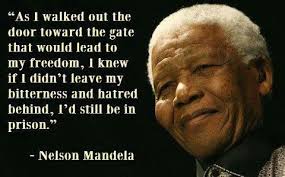
Perhaps the most difficult part is forgiveness. 

While we have the right to be angry when wronged, countless studies have shown that withholding forgiveness affects our own physical and mental health, hurting us more than anyone else.

What makes forgiveness so hard is the fact that, when we forgive, we forfeit the right to be angry with a person, waiving all opportunities to play passive aggressive; to weaponize our silence; to “win” an argument; or to seek revenge.

***

If you can do this – if you can truly forgive – then you’ve mastered part of Christianity.

If not, an honest effort is progress.

***

I am trying to forgive, but it feels like letting them off the hook?" -  Faith and Doubt

***

Image credits: (1) npr.org (2) medium (3) Nelson Mandela