Jesus went around to all the towns and villages, teaching in their synagogues, proclaiming the Gospel of the Kingdom, and curing every disease and illness. At the sight of the crowds, his heart was moved with pity for them because they were troubled and abandoned, like sheep without a shepherd. Then he said to his disciples, “The harvest is abundant but the laborers are few; so ask the master of the harvest to send out laborers for his harvest.”
Then he summoned his twelve disciples and gave them authority over unclean spirits to drive them out and to cure every disease and every illness.
The Gospel of the Lord.
***
***
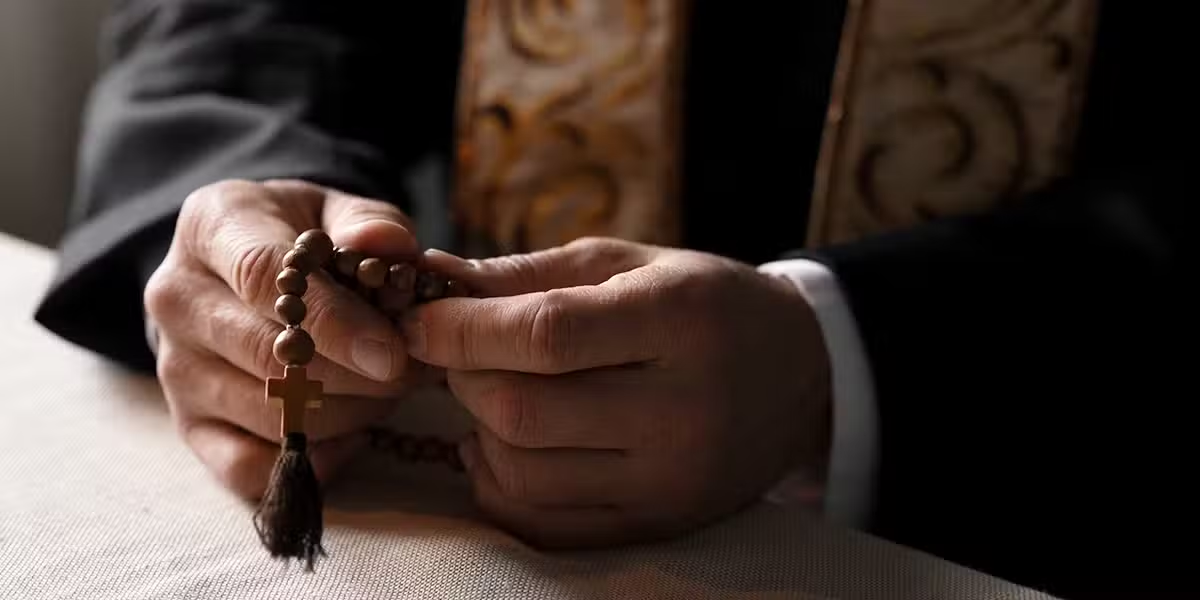
Today we celebrate the Feast of Saint John Vianney, the Patron Saint of priests.
John was born in 18th century France and raised by his parents who were humble farmers. Not receiving any formal education until he entered the seminary, John was never among the brightest students in his class, but he was known as among the holiest.
Three years after his priestly ordination, he was sent to the small town of Ars, with just 230 residents. There he not only dedicated his life to the spiritual care of the faithful; he also became known as a warm and gentle confessor.
As his reputation spread, John began spending up to 18 hours a day inside the confessional, administering the Sacrament to people from all around France – and beyond. Some estimates state that he eventually heard more than 20,000 confessions a year.
What was once a sleepy town in France became known as, “the great hospital of souls.”
***
Part of what made John such a unique priest was the fact that he was merciful to everyone who sought his counsel, imposing very minor penances on pilgrims, while performing much greater penances for them himself.
Examples included eating a very meager diet, as little as a single potato a day, while allowing himself a few meager hours of rest.
Before his death, John was quoted as saying, “If we really understood the priest on earth, we would die – not of fear, but of love.”
John understood that priests are not only Christ’s representative on earth, making the Lord present through the grace of the Sacraments; but priests are also called to live like Jesus, who gave his very Self for the sake of his flock.
***
Today let’s pray for all priests, especially for those in need of spiritual renewal, that like John, we’d be gentle confessors; embrace a life of penance; and bear the heart of the one whom we represent:
The Good Shepherd.
Jesus Christ.
***
***
Image credits: (1) Franciscan Media (2) Saint John Vianney, Wikipedia (3) Children of the Eucharist
Jesus made the disciples get into a boat and precede him to the other side of the sea, while he dismissed the crowds. After doing so, he went up on the mountain by himself to pray. When it was evening he was there alone. Meanwhile the boat, already a few miles offshore, was being tossed about by the waves, for the wind was against it. During the fourth watch of the night, he came toward them, walking on the sea. When the disciples saw him walking on the sea they were terrified. “It is a ghost,” they said, and they cried out in fear. At once Jesus spoke to them, “Take courage, it is I; do not be afraid.” Peter said to him in reply, “Lord, if it is you, command me to come to you on the water.” He said, “Come.” Peter got out of the boat and began to walk on the water toward Jesus. But when he saw how strong the wind was he became frightened; and, beginning to sink, he cried out, “Lord, save me!” Immediately Jesus stretched out his hand and caught him, and said to him, “O you of little faith, why did you doubt?” After they got into the boat, the wind died down. Those who were in the boat did him homage, saying, “Truly, you are the Son of God.”
After making the crossing, they came to land at Gennesaret. When the men of that place recognized him, they sent word to all the surrounding country. People brought to him all those who were sick and begged him that they might touch only the tassel on his cloak, and as many as touched it were healed.
The Gospel of the Lord.
***
***
Peter is understandably afraid. Until now, he’s only walked on land. Never would he have imagined walking on water, which could swallow him whole.
Still, the Lord dares Peter to step out of his comfort zone; to trust that he can do something new – something radical – with the Lord’s blessing.
We don’t know how far Peter walked, whether it was one foot or ten before the wind screamed and the waves reached high enough that he lost his newfound freedom and began to sink.
While he trusted Jesus, Peter was lighter than a feather. Only when fear filled his heart did he sink like lead.
***
With enough trust, I wonder if any of the other disciples could’ve also stepped out of the boat and walked on water. Was this an honor reserved strictly for Peter?
***
Maybe not.
After all, we’ve all walked in his sandals before, standing on the proverbial edge of the boat, knowing that Jesus is inviting us to step out and take a leap of faith.
Whether it’s something small, like a surge of grace leading us to extend or accept an apology.
An addict being invited to stand on the waters of sobriety.
A newly married couple feeling inspired to bring a child into the world.
A young person entering religious life.
Or an otherwise ordinary day when, suddenly, we have the impulse to do something kind, beautiful, or BIG for God.
***
Walking on land is boring. We do it all the time.
Every so often we’re called to get our feet wet. To step out and explore the deep, marveling at the one, “whom even the winds and the sea obey” (Matthew 8:27).
What might that look like for me today?
***
***
Image credits: (1) The Storm on the Sea of Galilee, Rembrandt (2) Meistr Dreuke (3) Family Radio
When Jesus heard of the death of John the Baptist, he withdrew in a boat to a deserted place by himself. The crowds heard of this and followed him on foot from their towns. When he disembarked and saw the vast crowd, his heart was moved with pity for them, and he cured their sick. When it was evening, the disciples approached him and said, “This is a deserted place and it is already late; dismiss the crowds so that they can go to the villages and buy food for themselves.” Jesus said to them, “There is no need for them to go away; give them some food yourselves.” But they said to him, “Five loaves and two fish are all we have here.” Then he said, “Bring them here to me,” and he ordered the crowds to sit down on the grass. Taking the five loaves and the two fish, and looking up to heaven, he said the blessing, broke the loaves, and gave them to the disciples, who in turn gave them to the crowds. They all ate and were satisfied, and they picked up the fragments left over— twelve wicker baskets full. Those who ate were about five thousand men, not counting women and children.
The Gospel of the Lord.
***
***
What happens when there is a shortage of something we value?
Think of the basics like food, land, and water. When human beings fear going hungry or thirsty, the worst in humanity can emerge. Suddenly, the world becomes a dog-eat-dog world, a zero-sum game.
My gain is your loss.
Strangely, this is not only true with basics like bread and water, but also with small conveniences like a plush roll of toilet paper or a prime parking spot.
I’m sure we’ve all seen videos of panic buying; people pushing and shoving before doors open on Black Friday; fists flying over the last toy on a shelf before Christmas; a ridiculous shooting over a parking space.
Or, worse, a stampede for a bowl of broth in a refugee camp.
When resources are scarce, people panic.
***
This is what makes the miracle of the multiplication of the loaves so intriguing. There are thousands of people who came to a remote place seeking Jesus. Now they’re hungry and in need of dinner.
The disciples only have five loaves of bread and two salted fish.
That’s barely a snack for these twelve grown men.
Thus, their reaction is understandable – send the crowds away! Allow them to fend for themselves. Perhaps their selfishness would’ve stung a little less had the setting for today’s Gospel been a food court in the mall.
But it’s not.
They’re in a deserted place, somewhere on the other side of the Sea of Galilee, where the Lord had hoped he could pray alone after hearing of the death of his cousin, John the Baptist.
Now the sun is setting, people are hungry, and the Lord must act. “Give them some food yourselves,” Jesus says, exhausted with the disciples’ lack of faith.
I imagine the look on their faces being one of bewilderment and frustration. How will their light fare ever be enough?
Suddenly, the Lord takes the bread and fish, raises his eyes to heaven, blesses it, and hands it back to his disciples, with the command to share.
Before dark, everyone is fed and satisfied – so much so that there are twelve wicker baskets filled with fragments – I’d imagine scraps of wheat, sourdough, rye, raisin, and pita.
More than enough for a “doggy bag” or two.
How did it happen? Where did all of this extra bread come from? Did these five meager loaves miraculously grow back every time someone tore off a piece?
Perhaps. If the Lord could heal the boils of leprosy, give sight to the blind, and even bring people back from death – the eternal unknown – then he could certainly bless a loaf of bread, causing it to rapidly regenerate.
But would that be the best possible outcome? Or could there have been an even greater miracle that day?
***
The multiplication of the loaves is the only miracle recorded in all four Gospels, which means it’s mentioned more than Christmas, more than the crucifixion, even more than the empty tomb! In fact, Matthew and Luke record it as happening twice.
This is undoubtedly a crown jewel in the Lord’s legacy, a feather in his cap.
Perhaps what made it so special was not five loaves of rapidly regenerating bread, but something entirely different. Imagine the disciples receiving their dinner, freshly blessed from the hands of the Lord.
Peter begins mumbling under his breath – something like, Great, another night of fasting – when, suddenly, a wave of empathy is stirred in the heart of his neighbor.
Realizing that Peter might otherwise go hungry, his neighbor breaks his silence, informing him and the other disciples that he, too, has a few slices of bread tucked away. So, he offers what he has to Peter and the others.
Slowly, people catch on, sharing whatever they have with others – bread, fish, even a little lamb wrapped in grape leaves or a few dates. And – voila! Everyone is filled.
This might be the real miracle – convincing people, even if only for an evening, to think beyond themselves. To work together, transforming the threat of scarcity into a blessing of abundance.
It was a simple menu, but a wholesome atmosphere.
***
Perhaps the problem with biblical miracles is the fact that we focus a little too much on Christ’s power – though infinite – while forgetting our own.
Christianity is an incarnational religion. We not only believe that God took on flesh 2,000 years ago, that he lived in a small city in Palestine, performed a few miracles, then was betrayed, crucified, and raised from the dead.
We believe that God continues working in this world through us – his hands and feet – as he issues and re-issues the command, “Give them something yourselves.”
Break your bread. Share your time. Give up a parking space. Stop waiting for a miracle to happen.
Become part of one, instead.
***
***
Image credits: (1) Miracle Living Today, CBN (2) Multiplication of the Loaves and Fishes, Heralds of the Gospel Magazine (3) Adobe Stock