Where is Heaven? Somewhere Over the Rainbow, Way Up High? (On the Feast of the Ascension)

***

Fifty-one years ago, a spacecraft named Apollo 11 was launched from the Kennedy Space Center in Florida, entering the earth’s orbit after only 12 minutes in flight.

Five days later, on July 21, 1969, Neil Armstrong opened the spacecraft’s doors, becoming the first person in history to step foot on the moon. 

Neil Armstrong FARTS during moon landing - YouTube

Perhaps some of you remember the moment he spoke prophetically from space, “That’s one small step for man, one giant leap for mankind.”

The mission, which has left its mark on our national consciousness, was hailed as a scientific triumph. We’ve been exploring space ever since, reaching out for new solar systems and galaxies.

Our universe, it seems, is an infinite stretch of combusting stars, black holes, asteroids and lifeless planets.

***

One could argue that landing on the moon has damaged our religious imagination. 

For millennia people arched their necks, squinted and stared into the bright blue sky, and prayed to the gods. 

Some still do.

How many of us, for example, have sung about heaven as a place, “Somewhere over the rainbow, way up high, where troubles melt like lemon drops, high above the chimney top”?

But science has revealed to us time and again that that isn’t true. Heaven isn’t, “Somewhere over the rainbow, way up high.” 

All that exists out there are countless galaxies devoid of life. So if heaven can’t be reached with a turbo-charged rocket, then where is it?

***

After all, on this Feast of the Ascension we celebrate our belief that Jesus was, “taken up into heaven.” 

So where in the world – or where in the universe – did he go? 

Are Dark Photons the Secret 'Fifth Force' Holding Our Universe ...

***

It’s a troubling question, especially for those of us with empirically driven minds.

But thinking about heaven in scientific terms can lead us astray, because Jesus didn’t rise from the earth like a rocket launched from the Kennedy Space Center; his resurrection isn’t something you can prove via autopsy or telescope.

Rather, as the Acts of the Apostles accounts, Jesus, “was lifted up, and a cloud took him out of their sight.”

That’s right.

Jesus returned to heaven enveloped in a cloud.

***

In the Bible, a cloud symbolizes much more than a puff of cotton-like matter floating effortlessly in the sky. 

A cloud represents the presence of God.

In the Book of Exodus, for example, Israel was led out of slavery in Egypt by the Lord, who appeared to them in a, “pillar of a cloud.” 

When Moses ascended Mount Sinai to receive the 10 Commandments, God descended upon him in a cloud.

And in Jesus’ own ministry, think of the moment that he led his disciples up a mountain and was transfigured before them. His body glowed like a light bulb and his clothes became dazzling white.

Then his Father appeared to them in a bright cloud saying, “This is my beloved Son in whom I am well pleased. Listen to him” (Matthew 17:5). 

Nobody saw the Father speaking from heaven; they only heard him hidden in a cloud.

And today Jesus ascends into heaven, once again, mysteriously enveloped in a cloud. 

05 May + Feast of the Ascension of Our Lord Jesus Christ T… | Flickr

***

So what’s the point?

Heaven isn’t some place over the rainbow; we can’t reach it with rockets or see it with telescopes. It’s not meant for our eyes to behold – or our bodies to touch.

Not yet. 

Entrance into heaven only comes after living a life of faith in the Son of God, who has, “loved us and given himself for us” (Ephesians 5:2).

What we must focus on in the here-and-now is how we can follow Jesus just a little better – day-by-day, step-by-step. 

But before you know it, we’ll be knock, knock, knockin’ on heaven’s door, a place that isn’t somewhere over the rainbow. 

No. It’s a place far beyond our wildest dreams.

Stay tuned.

As Christians, We’re Invited to Share Our Faith…but humbly. (A Morning Meditation, Acts 17:15-18:1)

***

Athens was one of the most diverse cities in the ancient world. It was a city of intellects – and a city of gods. 

There were so many, some used to say, “In Athens, it is easier to meet a god than a person.” 

Statues, temples and altars were everywhere. 

Perhaps you’ve seen the most famous temple of them all, the Parthenon, located smack dab in the heart of Athens.

There, Greeks could offer sacrifices to any god they wanted, including at the altar to the, “unknown god.” 

Though the Greeks worshipped a god of the sky, a god of the sea, a god of wine and so on, they also worshipped an “unknown god,” because they could not box the Divine in.

God was bigger than they could ever imagine.

***

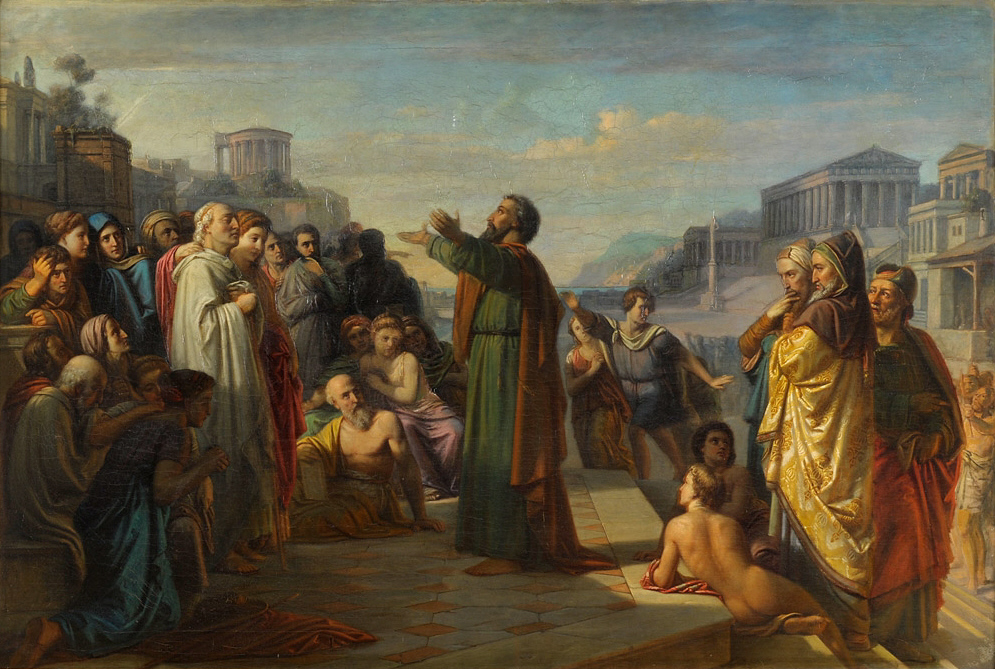
Enter Saint Paul.

File:Paulus in Athen 19Jh.jpg - Wikimedia Commons

***

Imagine him standing in the shadow of the Parthenon, where he begins preaching about Jesus. He is the “Unknown God,” the one through whom everything was created. 

If the Greeks want to worship God in his fullness, then they should worship Jesus. 

Amazingly, some are converted on the spot.

But they follow Saint Paul for two reasons: he makes logical arguments about our faith – he shows why it’s true… and he does so humbly

He doesn’t make them feel like fools.

***

So many in our Church could learn from Paul’s example. 

Just because we know who God is, doesn’t mean that we should bear hatred or judgment in our hearts towards others who, like the Greeks, have an incomplete picture of God.

Rather, we should humbly dialogue with them, knowing that the truth converts people, but only when the messengers preach with love, not with arrogance.

How, then, can we share the Gospel message of salvation through Jesus humbly with others today?

***

Paul's Speech to the Athenians · Blog from Author & Methodist ...
(The Parthenon. Athens, Greece.)

Joy in the Midst of Suffering: A Lesson from Saint Paul (Acts 16:22-34)

***

There’s an old Swedish proverb: “Those who wish to sing always find a song.”  

***

In our first reading from Acts, Paul and Silas have been humiliated, stripped in public, and beaten with rods. 

Now they’re imprisoned; chained to the ground in the bowels of the earth, singing songs to God at midnight. 

Paul and Silas were nearly killed. But instead of cowering in fear, they sing.

This description of persecution and imprisonment represents a constant theme in the Book of Acts: The Church meets trouble.

And while trouble abounds, there’s always the consolation of the Spirit. 

***

Those who wish to sing, even while bruised in prison, always find a song.

***

After Paul and Silas break out in song, the belly of the earth begins to shake, freeing them from their cell. But they do not flee. They stay and convert the prison guard, instead.

Paul reveals to the guard a higher freedom, a freedom that cannot be chained; the freedom of belief in Jesus Christ.

It is he who gives us strength when we cannot find it ourselves.

This is a great, almost original, insight of Paul – that even in the midst of suffering, there is grace.

***

“Those who wish to sing always find a song.” 

***

Hopefully we’ll never know the darkness of imprisonment as Paul and Silas did, but we’ve all endured various trials – dryness in prayer, periods of grief, sickness, unemployment, frustration. 

Like these first Christians, we can always find a song, even at midnight, for the same God of consolation is with us.