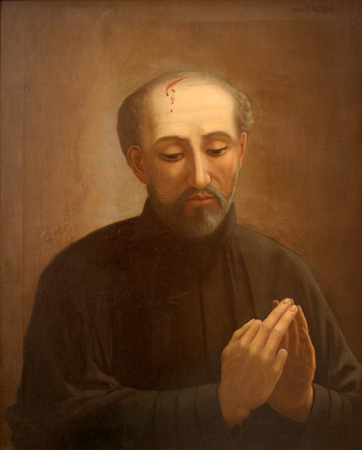
Saint Isaac Jogues was a French-born missionary who was one of the first Jesuits to try evangelizing the Native Americans.
Within a few years of landing on the shores of America, he was beaten, tortured, imprisoned, and eventually killed.
***
***
On the surface, his mission seemed like a failure.
But nine years after his death, a young Native American girl was born near the site where Isaac died. This girl later became the first Native American Saint, who’s feast day we celebrate today.
Her name was Kateri Tekakwitha.
***
Kateri’s parents and younger brother died in a smallpox epidemic when she was four. She herself was left disfigured and half blind.
But as she reached her teenage years, she began interacting with other Jesuit missionaries who followed in the footsteps of Isaac Jogues.
They taught her about Jesus, baptized her, and welcomed her into their small Christian community, where she dedicated herself to Christ, living a life of prayer, fasting, and penance.
If only Isaac had known how fruitful his efforts would be!
But his life reminds us of an important lesson in faith:
We don’t always get to see the fruit of our labor.
***
It’s easy to feel discouraged when we share our faith with others, as Isaac did, and we don’t immediately see the results.
But we should never give up. Keep planting seeds of faith.
God will watch over its growth.
***
Who knows, your life and example may also lead to the birth of a Saint.
***
Image credits: (1) Ignatian Solidarity Network (2) Wikimedia Commons (3) Fine Art America, Terezia Sedlakova
Jesus said to his Apostles: “Do not think that I have come to bring peace upon the earth. I have come to bring not peace but the sword. For I have come to set a man against his father, a daughter against her mother, and a daughter-in-law against her mother-in-law; and one’s enemies will be those of his household.
“Whoever loves father or mother more than me is not worthy of me, and whoever loves son or daughter more than me is not worthy of me; and whoever does not take up his cross and follow after me is not worthy of me. Whoever finds his life will lose it, and whoever loses his life for my sake will find it.
“Whoever receives you receives me, and whoever receives me receives the one who sent me. Whoever receives a prophet because he is a prophet will receive a prophet’s reward, and whoever receives a righteous man because he is righteous will receive a righteous man’s reward. And whoever gives only a cup of cold water to one of these little ones to drink because he is a disciple– amen, I say to you, he will surely not lose his reward.”
When Jesus finished giving these commands to his Twelve disciples, he went away from that place to teach and to preach in their towns.
The Gospel of the Lord.
***
***
“Whoever does not take up his cross and follow after me is not worthy of me.”
These are some of the most famous – and difficult – words ever spoken by Jesus. Why must we carry a cross? What kind of cross? Does God invite suffering?
***
Jesus doesn’t want us looking for a cross; he isn’t asking us to carry extra burdens. In fact, Jesus wants to help lift them. So what kind of cross is he referring to?
That clumsy, awkward, often hard to carry cross called life.
We might re-interpret Jesus’ words to say: “Whoever wishes to come after me must deny himself, take up his life, and follow me.”
***
So many of us have children to provide for, difficult jobs, illnesses and grief in our hearts.
For some, there’s the added stress of marriage, bills, sobriety, an aging spouse or parent, and our inner attempts to grow in virtue.
We don’t have to add any extra weight to our shoulders.
We simply can’t shrug it off.
That’s the cross.
***
What Jesus asks of us is simply to devote ourselves to the tasks we’ve been given in life.
If you’re a parent, provide generously for your children; affirm them; shower them in love. If you have a job, do the things no one else wants to do – and do it without a complaint.
If you’re a recovering addict, continue on the road to sobriety. If you’re burdened with an illness, endure it in faith. If you’re caring for a loved one who’s sick, do so tenderly.
***
“Whoever wishes to come after me must deny himself, take up his life, and follow me.”
But do so knowing that the Lord is shouldering your burdens with you, sometimes making what seems impossible to carry, possible.
“Behold,” Jesus says, “I am with you until the end of the age.”
Jesus summoned the Twelve and began to send them out two by two and gave them authority over unclean spirits. He instructed them to take nothing for the journey but a walking stick— no food, no sack, no money in their belts. They were, however, to wear sandals but not a second tunic. He said to them, “Wherever you enter a house, stay there until you leave. Whatever place does not welcome you or listen to you, leave there and shake the dust off your feet in testimony against them.” So they went off and preached repentance. The Twelve drove out many demons, and they anointed with oil many who were sick and cured them.
The Gospel of the Lord.
***
***
One of my favorite books is called, The Poisonwood Bible.
Have you read it?
***
It’s a story about the Price family from my home state of Georgia. The father, Nathan, is a Baptist minister whose church has appointed him to be a missionary in central Africa, in what was the 1960’s Belgian Congo.
Overjoyed, Nathan decides to bring his entire family along, including his four young daughters, ranging in age from 5 to 16.
Before they go, friends warn them that there’s a weight limit at the airport; each person can only bring forty-four pounds of luggage.
So, the girls rush to their rooms and start putting on as much of their clothes as possible – several pairs of socks each, six dresses, cake mix buckled around their waists, all covered by thick winter coats.
It was just about everything they owned.
“But Daddy,” his youngest daughter says, “he only brought the Word of God. Said it’s all he needed!”
He must’ve read today’s Gospel.
***
And yet, when they arrive at the airport, the Price family’s luggage is sixty-one pounds overweight! Slightly embarrassed, they begin digging through their belongings, deciding what items are essential versus what can be left behind.
This gesture of removing items from their suitcase – of tossing out what no longer serves them – pointed to something deeper… something they, we, and the disciples in today’s Gospel, all must to do.
In order to fulfill their mission, and in order for us to live Christian lives, we must leave more than physical luggage behind.
***
In today’s Gospel, Jesus sends the Apostles out on their first missionary journey, instructing them to take nothing with them – no food, no cash, no suitcase. Not even a change of clothes.
Like Doug, the Baptist minister in The Poisonwood Bible, all they have is the Word of God.
***
Why does Jesus strip his disciples of their basic necessities? Hasn’t he taken their dignity?Why insist on such extreme poverty?
***
***
The disciples’ poverty will lend credibility to their message.
By driving out demons and curing the sick for free, they’ll show others they’re not looking to get rich; they’re looking to save souls. All they want in exchange for these miracles is for people to believe – and to behave accordingly.
As Saint Peter later writes to one of those early Christian communities, “Your faith is more precious than fire-tried gold,” because it leads to what matters most, your salvation.
Secondly, Jesus wants the disciples to learn how to trust in the midst of suffering. Not knowing where their next meal will come from or who will offer them shelter that night strips them of that natural human tendency towards self-reliance.
Relying upon the Lord instead of themselves will make them learn the meaning of those sacred words Jesus taught them, “Give us this day, our daily bread.”
Similarly, their poverty will instill the virtue of charity into those first Christian communities, instructing those who have more to share with those who have less. As Jesus taught them, “Whatever you do to the least of these, my brothers and sisters, you do to me.”
***
Though we’re not impoverished missionaries like the Apostles, or the Price family in The Poisonwood Bible, the Gospel still challenges us to unpack the suitcases in our lives, considering what things we can leave behind versus what is essential.
On the surface, that may mean something physically. As the common saying goes, “Simplify, simplify, simplify.”
But must we wait until the kids go off to college before we downsize? Or are there ways we can live more simply even now?
(It’s amazing what a priest, a man living on his own, can also accrue.)
***
Perhaps we’re also being invited to unpack those suitcases within.
Coming out of this pandemic, maybe we picked up a habit that we need to drop. Perhaps we experienced a heated family argument, leaving anger or frustration inside. Or maybe we need to rid ourselves of an unhealthy fear or painful memories.
This is the harder question: what baggage do I need to empty from my heart?
***
“Jesus instructed them to take nothing for the journey.”
No food, no cash, no suitcase. Not even a change of clothes. Nothing that weighed them down in mind, heart, body, or ministry.
The same is true for us.
Life is a journey. At times it can feel long and difficult. The more we empty ourselves of unnecessary baggage – things that no longer serve us either externally or internally – the easier and more lighthearted our journey becomes.