An argument arose among the disciples about which of them was the greatest. Jesus realized the intention of their hearts and took a child and placed it by his side and said to them, “Whoever receives this child in my name receives me, and whoever receives me receives the one who sent me. For the one who is least among all of you is the one who is the greatest.”
Then John said in reply, “Master, we saw someone casting out demons in your name and we tried to prevent him because he does not follow in our company.” Jesus said to him, “Do not prevent him, for whoever is not against you is for you.”
The Gospel of the Lord.
***
***
Two weeks ago, this was also our Sunday Gospel. “The greatest among you must be your servant,” Jesus says.
The lowly is exalted; the poorest becomes the greatest.
***
I began that homily with the story of Cinderella, which has a surprisingly Christian twist: Cinderella, the lowly house servant wins the prince’s heart, becoming a princess.
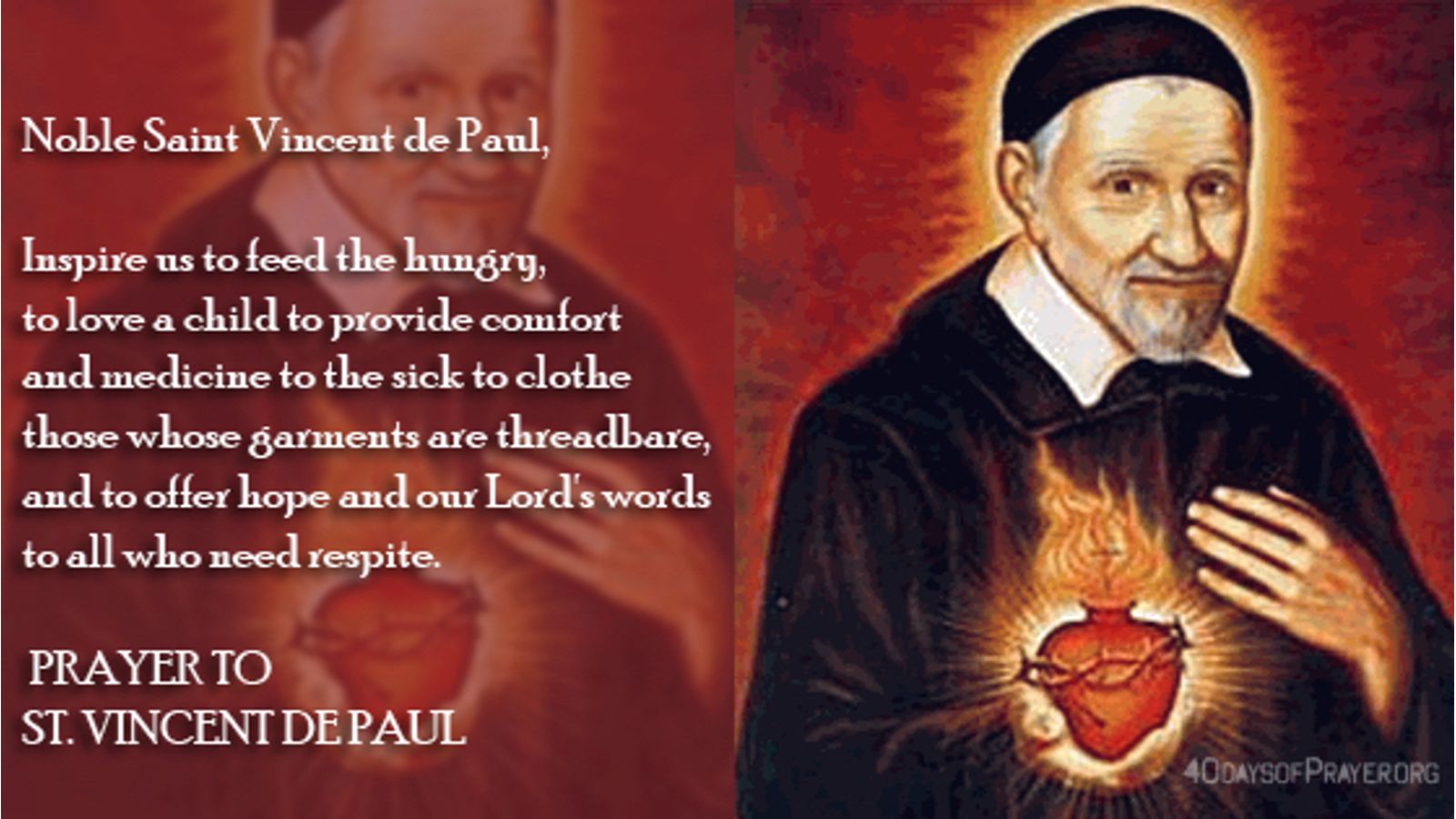
Today we celebrate a real-life Cinderella story, as it were. Saint Vincent de Paul spent his life serving the poorest of the poor. Now he’s been given the greatest gift of all: eternal life.
***
Vincent came from very humble means, born into a peasant family in the French countryside in the 16th century. As a young man, he was even kidnapped at sea, spending two years of his life as a slave.
After evading his captors, Vincent returned to France, where he was ordained a priest and began his mission of providing for the poor. The demands for his charity became so great that he started a religious order for both men and women.
Today the Society of Saint Vincent de Paul has grown to 800,000 active members – both lay and religious – in over 150 countries.
They continue the work Vincent began: serving in soup kitchens, offering disaster relief, job training, medical services, prisoner re-entry programs, and so on.
***
In doing this work, each member follows the path of Vincent (and even Cinderella), a path that leads from poverty to greatness; from service to eternal life.
How might we follow their example and be of service to others today?
***
***
Image credits: (1) St. Vincent de Paul, Positive Living (2) Jesus Washing Peter’s Feet, Ford Madox Brown (3) St. Vincent de Paul Society
At that time, John said to Jesus, “Teacher, we saw someone driving out demons in your name, and we tried to prevent him because he does not follow us.” Jesus replied, “Do not prevent him. There is no one who performs a mighty deed in my name who can at the same time speak ill of me. For whoever is not against us is for us. Anyone who gives you a cup of water to drink because you belong to Christ, amen, I say to you, will surely not lose his reward.
“Whoever causes one of these little ones who believe in me to sin, it would be better for him if a great millstone were put around his neck and he were thrown into the sea. If your hand causes you to sin, cut it off. It is better for you to enter into life maimed than with two hands to go into Gehenna, into the unquenchable fire. And if your foot causes you to sin, cut if off. It is better for you to enter into life crippled than with two feet to be thrown into Gehenna. And if your eye causes you to sin, pluck it out. Better for you to enter into the kingdom of God with one eye than with two eyes to be thrown into Gehenna, where ‘their worm does not die, and the fire is not quenched.'”
The Gospel of the Lord.
***
***
Later this afternoon, we’ll kick off our parish’s very first Color Run! Would you believe that over 60 young people have registered, along with nearly two dozen volunteers?
If you’re unfamiliar with what a Color Run is, basically people will run a particular path around the church, and at certain points will get pummeled with colored powder. Strangely, it’s wildly popular!
Before the runners start the race, each person will be given sunglasses, a bandana, and of course, a reminder to tie their shoes. The last thing anyone wants is to trip and fall.
***
***
It hurts when we trip and fall, doesn’t it?
***
In fact, this is what the verb “to sin” originally meant: to trip and fall. Much like a physical fall, when we sin it can hurt our bodies, or worse our relationship with God and with others.
***
In today’s Gospel, Jesus uses very strong language, urging us to be aware of those ways in which we fall – not in the sense of physically tripping – but the ways we stumble morally or spiritually.
***
For example, the disciples have become terribly possessive of their ministry.
“Teacher, we saw someone driving out demons in your name,” they say in today’s Gospel, “and we tried to prevent him because he does not follow us.”
The disciples don’t want others to perform good works; they want to do everything themselves, which leaves us wondering, who really is the focus of their ministry?
Is it about glorifying God? Or honoring themselves?
Remember, in last week’s Gospel, the disciples were caught arguing about who was the “greatest.” Now they selfishly don’t want to share their ministry with others! In spite of last week’s lesson on service, it seems that nothing has changed.
Here they are stumbling – caught being sinful – once again.
But I find something strangely comforting about that. Jesus didn’t choose people who were perfect to lead his Church; he chose ordinary people, imperfect believers, works in progress.
He was patient with them until the very end – and, in spite of their stumbling, they still spread the kingdom of God.
***
So, in what ways do we stumble like the disciples?
In terms of our faith and character, when do we trip and fall?
***
Perhaps we compare ourselves with others, arguing over who is the greatest; the most popular; the most athletic; the wealthiest; the most attractive.
Or maybe find ourselves being selfish from time to time. Selfishness creeps into our hearts whenever we start living in a world of “me,” not “we.” It happens in marriage, in friendship, in ministry, and in some of the tiny daily decisions we make.
On a personal level, I hear Christ reminding me to turn away from that possessive attitude set by the disciples in today’s Gospel.
Instead of trying to exclude others from being involved in ministry, we should always be asking ourselves how we can increase participation, creating a culture of inclusivity, shared leadership, and collaboration.
I’m inspired, in particular, by the collaborative efforts we’ve begun on our pastoral council and youth group, which has provided the energy and planning needed for today’s Color Run.
***
At the end of the Color Run this afternoon, all of the participants will receive a prayer card with a verse from Saint Paul: “I have run the race of life to the finish and kept the faith.”
In the big picture, this is our hope for everyone: that we run the race of life to the finish and keep the faith.
But for now that little prayer card – and the Color Run itself – is a little reminder that, though we may stumble along the way, we’re all in this together, building up the kingdom of God one day at a time.
***
***
Image credits: (1)My Stumbling in Faith, WordPress (2) Sermon on the Mount, Carl Heinrich Bloch (3) Mpumalanga News (4) Active.com
Once when Jesus was praying in solitude, and the disciples were with him, he asked them, “Who do the crowds say that I am?” They said in reply, “John the Baptist; others, Elijah; still others, ‘One of the ancient prophets has arisen.’” Then he said to them, “But who do you say that I am?” Peter said in reply, “The Christ of God.” He rebuked them and directed them not to tell this to anyone.
He said, “The Son of Man must suffer greatly and be rejected by the elders, the chief priests, and the scribes, and be killed and on the third day be raised.”
The Gospel of the Lord.
***
***
The disciples have just returned from their first missionary journey, casting out demons and healing the sick. While sharing what fruit their adventure has yielded, Jesus asks them what people are saying; what’s the gossip going on in town?
He knows his actions and theirs have caused quite the stir – and rightfully so – and so he wonders, “Who do people say that I am?”
Only Peter gets it right. “The Christ of God.”
***
Now that they see the big picture – they understand that Jesus is divine – he reveals more about his identity and plans.
“The Son of Man must suffer greatly and be rejected…and be killed and on the third day be raised.”
Such a serious turn of events would leave anyone confused and stunned. Just when Peter thought he had things figured out, Jesus turns his assumptions upside down. How can Jesus be so powerful – how can he be God! – and still suffer?
Surely, Jesus is mistaken.
Shortly after this Gospel passage, Peter pulls Jesus aside and rebukes him, which leads to Jesus then calling Peter, “Satan.”
Again, a terribly confusing turn of events.
But this is often what it’s like on the journey of faith. Just when we think we have God figured out, he reveals something else about himself.
***
“So, who do you say that I am?”
***
So long as we never lose sight of Christ’s divinity – so long as we keep placing our trust in him – then we will never be lost.
We may be confused at times, but we must trust like Peter that the Lord knows what he’s doing and where he’s ultimately leading us: to eternal life.
***
***
Image credits: (1) New Hope International Ministries (2) The Kingdom New Testament, NT Wright (3) Abiding Savior Free Lutheran Church