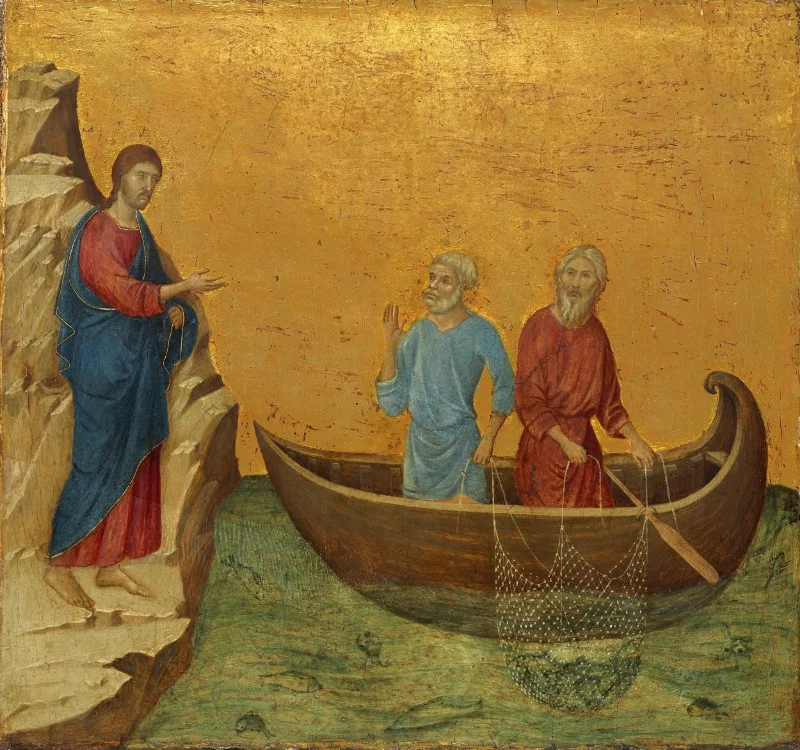
After John had been arrested, Jesus came to Galilee proclaiming the Gospel of God: “This is the time of fulfillment. The Kingdom of God is at hand. Repent, and believe in the Gospel.”
As he passed by the Sea of Galilee, he saw Simon and his brother Andrew casting their nets into the sea; they were fishermen. Jesus said to them, “Come after me, and I will make you fishers of men.” Then they left their nets and followed him. He walked along a little farther and saw James, the son of Zebedee, and his brother John. They too were in a boat mending their nets. Then he called them. So they left their father Zebedee in the boat along with the hired men and followed him.
The Gospel of the Lord.
***
***
A few years ago, I spent the summer volunteering at the Shrine of Our Lady of Fatima in Portugal.
One morning I noticed an old blind priest shuffling in to celebrate Mass. Holding onto the arm of a young man, he bent over to kiss the altar.
“Now, how is he going to celebrate Mass?” I wondered. “He’s blind!”
***
After being guided to his chair, the priest was handed a set of headphones and a tape player.
“In the name of the Father, and of the Son, and of the Holy Spirit,” he said.
Then it hit me…the young man who escorted him in for Mass recorded all of the prayers ahead of time, so that the priest could listen to his voice and then repeat what he heard.
***
That bond between the elderly priest and the young man reminded me of two things we find in today’s Gospel: the desire for friendship and the invitation to hand on our faith.
Like us, Jesus wanted friends to share his journey with, and he needed witnesses to hand on their faith in him, which is why he calls Peter, Andrew, James, and John.
They will continue the good work that he begins.
***
In that sense, faith and friendship are connected. Like that young man learning from a blind priest, we learn about Jesus from others.
Then we’re invited to hand on that faith.
So, who might I share my faith with today?
***
***
Image credits: (1) WomenLivingWell.org (2) Duccio di Buoninsegna, The Calling of the Apostles Peter and Andrew (3) Pravmir.com
The people were filled with expectation, and all were asking in their hearts whether John might be the Christ. John answered them all, saying, “I am baptizing you with water, but one mightier than I is coming. I am not worthy to loosen the thongs of his sandals. He will baptize you with the Holy Spirit and fire.”
After all the people had been baptized and Jesus also had been baptized and was praying, heaven was opened and the Holy Spirit descended upon him in bodily form like a dove. And a voice came from heaven, “You are my beloved Son; with you I am well pleased.”
The Gospel of the Lord.
***
***
Take a deep breath and close your eyes if you wish.
Imagine you’re standing in the middle of a river.
You know this river has a beginning and an end, but you’re at neither place; you’re standing knee-deep, somewhere in between.
Listen to the water trickle, feel it brushing against you, watch it flow peacefully downstream. If you follow the current, then you’ll notice a series of twists and turns along the river’s path.
In spite of these twists and turns, the rocks, and the brush, the river finds the energy to flow forward, never stopping until it reaches its final destination.
***
If your eyes are closed, now open them.
***
Perhaps this image of a river is an appropriate image for our own lives. Like that river, you and I are neither at the beginning nor the end; we’re standing somewhere in between.
And in spite of the obstacles we face – the twists, the turns, the rocks, the brush – we, too, must find the energy to move forward.
What are the rocks in my river, the obstacles in my path?
***
It could be anything from stress, to anxiety, loneliness, grief, a particular temptation or habit, or uncertainty about the future.
When I brush up against these rocks – when life is difficult – how do I cope? Or who do I turn to?
***
Perhaps we hold everything in and we rely upon ourselves. May we turn to a self-help book or to a friend.
Do we also turn to God?
***
In today’s Gospel, Jesus has reached the most important turn in the river of his life.
He’s thirty years old. Ninety-percent of his life has already been written. His baptism by John in the Jordan River marks the beginning of his public ministry – and, by extension, the final three years of his life.
In order to successfully navigate the remaining twists and turns ahead, Jesus must turn to his heavenly Father for guidance.
As the Gospels describe, after being plunged into the Jordan, Jesus emerges – and prays. Suddenly, the heavens are opened, the Spirit descends in the form of a dove, and his Father says, “You are my beloved Son; with you I am well pleased.”
Here Jesus teaches us an important lesson: whenever we begin doing the work of God, we must pray.
So, we find Jesus praying after his baptism; before he elects his disciples; while he is transfigured before them; before he is arrested in the Garden of Gethsemane; and even while he’s dying on the cross.
At every turn in his life, Jesus prayed.
***
What is my prayer life like?
Is it strong and deep like a river? Shallower like a stream? Or, dried up like a creek in the sun?
***
I’ve found each day I spend in prayer like a drop of water; it seems insignificant at the time. The heavens aren’t visibly opened as they were for Jesus; I don’t see the Spirit descend like a dove; I don’t audibly hear the voice of God.
But, over time, those daily drops of water create an ocean – and that makes all the difference.
It’s partly why we greet – and pray for – one another at Mass. Every Sunday is like another drop of water, saturating our souls with grace.
***
Perhaps it’s appropriate, then, to conclude with a prayer.
I invite you to take another deep breath and to close your eyes.
Let us pray:
Heavenly Father, we come before you this morning seeking your strength, wisdom, and peace in 2022. The river of our lives is often filled with obstacles – brush, twigs, and rocks – that obscure our path. Soften our hearts to your will. Guide us through the many twists and turns that lie ahead, just as you guided your Son, Jesus, so that one day we may join Him and all who’ve flowed before us into your kingdom, where you live and reign forever and ever. Amen.
***
***
Image credits: (1) The Irish Times (2) ArtMajeur.com (3) The Irish Times
It happened that there was a man full of leprosy in one of the towns where Jesus was; and when he saw Jesus, he fell prostrate, pleaded with him, and said, “Lord, if you wish, you can make me clean.” Jesus stretched out his hand, touched him, and said, “I do will it. Be made clean.” And the leprosy left him immediately. Then he ordered him not to tell anyone, but “Go, show yourself to the priest and offer for your cleansing what Moses prescribed; that will be proof for them.” The report about him spread all the more, and great crowds assembled to listen to him and to be cured of their ailments, but he would withdraw to deserted places to pray.
The Gospel of the Lord.
***
***
Leprosy was a disease that disfigured, and in some cases, slowly ate away at a person’s flesh.
Part of why people intentionally kept their distance from lepers was because they didn’t know how leprosy was contracted. It sparked panic among people, much like COVID does today.
When approaching the edge of town, for example, lepers had to cry out, “Unclean! Unclean!”
A warning to others: stay away.
***
The damage caused by this disease was not only physical; it was also psychologically and emotionally devastating.
Lepers lived entirely alone.
***
Thus, the physical healing of this man’s body was only the beginning of his journey.
Jesus did his part. He cleansed the man’s flesh.
But now the community must do theirs. They must welcome a man they once feared, seeing him not as a leper, but as a brother.
In that sense, the community must be healed, too; they need to be cleansed from their fear of him.
***
It’s not easy making room in our hearts for “lepers” – the black sheep; those who’ve hurt us, but seek forgiveness; the recovering addict; people whom we disagree with; or who are different from us.
But when God acts in their lives, initiating some form of healing, we must continue the good work begun within them.
For example, when a person who’s hurt us asks for forgiveness – give it. God placed the desire for reconciliation in their hearts. Now we should try to welcome them back.
Or when an addict turns sober, a person is released from prison, or a loved one sincerely asks for a second chance –offer it. Give them the opportunity to rebuild trust.
***
In each case, Jesus begins the healing, but we’re called to continue it.
***
***
Image credits: (1) Community Tool Box, University of Kansas (2) Osprey Observer (3) Forgiveness and Reconciliation, iBenedictines