Jesus said to his disciples: “Be merciful, just as your Father is merciful.
“Stop judging and you will not be judged. Stop condemning and you will not be condemned. Forgive and you will be forgiven. Give and gifts will be given to you; a good measure, packed together, shaken down, and overflowing, will be poured into your lap. For the measure with which you measure will in return be measured out to you.”
The Gospel of the Lord.
***
***
If you have ever played a video game, then you know that there is always a series of levels.
The first level is the easiest, and the final level is the hardest. Sometimes it takes multiple tries before you succeed in beating that final level.
But if you do, then you’ve mastered the game.
***
If Christianity were likened to a video game, then today’s Gospel would be part of that final level: stop judging; stop condemning; forgive without limit; love wholeheartedly.
If you can do these things then you’ve mastered most of Christianity.
***
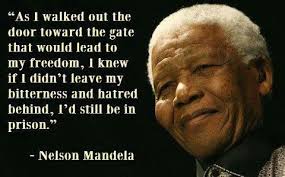
Perhaps the most difficult part is forgiveness.
While we have the right to be angry when wronged, countless studies have shown that withholding forgiveness affects our own physical and mental health, hurting us more than anyone else.
What makes forgiveness so hard is the fact that, when we forgive, we forfeit the right to be angry with a person, waiving all opportunities to play passive aggressive; to weaponize our silence; to “win” an argument; or to seek revenge.
***
If you can do this – if you can truly forgive – then you’ve mastered part of Christianity.
If not, an honest effort is progress.
***
***
Image credits: (1) npr.org (2) medium (3) Nelson Mandela
Jesus took Peter, John, and James and went up the mountain to pray. While he was praying his face changed in appearance and his clothing became dazzling white. And behold, two men were conversing with him, Moses and Elijah, who appeared in glory and spoke of his exodus that he was going to accomplish in Jerusalem. Peter and his companions had been overcome by sleep, but becoming fully awake, they saw his glory and the two men standing with him. As they were about to part from him, Peter said to Jesus, “Master, it is good that we are here; let us make three tents, one for you, one for Moses, and one for Elijah.” But he did not know what he was saying. While he was still speaking, a cloud came and cast a shadow over them, and they became frightened when they entered the cloud. Then from the cloud came a voice that said, “This is my chosen Son; listen to him.” After the voice had spoken, Jesus was found alone. They fell silent and did not at that time tell anyone what they had seen.
The Gospel of the Lord.
***
***
Have you heard the story of Harriet Tubman and the Underground Railroad?
***
Harriet was born into slavery in 19th century America. After years of forced labor, she ran away from her captors, finding freedom in the North.
What makes her story so incredible is the fact that, after finding her own way to freedom, Harriet turned around and spent the next 10 years of her life helping others to do the same.
Estimates are she led hundreds of people to freedom.
***
By all accounts, the Underground Railroad was a dangerous journey. It took weeks to complete, because Harriet and her “passengers” as she called them, could only move at night under the cover of darkness out of fear of being caught – or worse, killed.
Throughout the perilous journey, every “passenger” remained by her side, because only Harriet knew the way.
And in the end, she is quoted as saying, “In all of my travels, I never lost a single passenger.” Everyone who followed Harriet on the Underground Railroad made it safely to the North.
***
A similar journey is happening with Jesus and his disciples.
Just as Harriet promised to lead others into freedom, so Jesus promises to lead his disciples into eternal life.
And only Jesus knows the way. In fact, he tells us, he IS the way.
***
If heaven is our final destination, then have you ever wondered what it is like?
***
Today’s Gospel offers us a clue.
Consider what Peter sees.
Peter not only sees Jesus. He also sees Moses and Elijah, prophets from the Old Testament who lived hundreds of years before him. Somehow, they’re alive again!
They’re standing right in front of him, speaking with Jesus.
Peter sees their bodies and their faces; he knows Moses and Elijah by name; he can distinguish between the two of them; and he recognizes each of them by the good works they did in life – they were prophets.
So, what does this mean?
Moses’ and Elijah’s earthly identities – their names, their bodies, and their memories – remain intact in heaven.
***
The same will be true for us.
When we enter the presence of God, we keep our names, our faces, and all of the good works we do in life.
***
I often use this Gospel passage to teach younger generations about heaven, but I use a different analogy – not Harriet Tubman, but iPhones.
So, how many of you have an iPhone?
If I took your phones and threw them into a lake, you wouldn’t have to panic. You could go to the Apple store and buy a brand-new phone on me. Better yet, I’d give you an upgrade for your troubles.
Sounds like a pretty good deal to me.
In order to retrieve all of your photos, apps, and contacts, you simply upload them from the iCloud. Although you exchanged one phone for another, your data was never lost; it was kept safely in the iCloud.
***
The same was true for Moses and Elijah – and the same will be true for us. When we go to heaven, we exchange our earthly bodies for heavenly ones. Then all of our memories are “uploaded” onto our new, heavenly bodies.
As we hear in our second reading, “Jesus will change our lowly body to conform with his glorified body.”
How is this possible, you wonder?
***
God is the original iCloud. God stores up all of our earthly memories for us so that we are never forgotten.
***
So, who is my Moses? Who is my Elijah? Who do I want to see again in heaven?
***
One person I long to see is my mother. And this Gospel passage assures me that when I go to heaven, I will recognize her – and she will recognize me.
I imagine I’ll say with Saint Peter, “Master, it is good that we are here.”
This is the reason for my hope; it’s what inspires me on my journey – the belief that just as every “passenger” who followed Harriet Tubman on the Underground Railroad made it safely into the North, so everyone who follows Jesus will make it safely into eternal life.
May we continue following Him today, knowing the glory that awaits us.
***
***
Image credits: (1) Transfiguration, Carl Bloch (2) NBC 7 San Diego (3) Ascension, John Singleton Copley
Queen Esther, seized with mortal anguish, had recourse to the LORD. She lay prostrate upon the ground, together with her handmaids, from morning until evening, and said: “God of Abraham, God of Isaac, and God of Jacob, blessed are you. Help me, who am alone and have no help but you, for I am taking my life in my hand. As a child I used to hear from the books of my forefathers that you, O LORD, always free those who are pleasing to you. Now help me, who am alone and have no one but you, O LORD, my God.
“And now, come to help me, an orphan. Put in my mouth persuasive words in the presence of the lion and turn his heart to hatred for our enemy, so that he and those who are in league with him may perish. Save us from the hand of our enemies; turn our mourning into gladness and our sorrows into wholeness.”
The Word of the Lord.
***
***
What do we do when we enter a dark place?
***
We either drown in despair or look for a reason to hope.
***
In our first reading, Queen Esther has entered a very dark place.
Though she’s a Jew, she’s married to a foreign king who doesn’t know about her Jewish identity. One day while in his court, she overhears a plan to exterminate the Jews, a theme that’s repeated itself throughout history.
If Esther tells the king that she’s also a Jew, then she may be killed. But if she remains silent, then thousands will be slaughtered.
What is she to do? Will her objection make any difference?
***
In her darkest hour, Esther turns to the Lord, saying, “Help me, who am alone and have no one but you, O LORD, my God.”
“Help me.”
***
By the end of the story, Esther musters up the courage to plead with the king, who then relents; the Jews are saved.
***
In a sense, that’s what Lent is all about: crying out to the Lord in our hour of need.
Maybe we’re not in a dark place like Ester. Maybe we simply need God’s grace to change a habit, adjust an attitude, or tweak our perspective.
Regardless of where we are this Lent, Esther reminds us that prayer changes things. May we turn to the Lord in our hour of need.
***
***
Image credits: (1) Coffee With The Lord (2) Pinterest, Bible Art (3) Voice of God Recordings